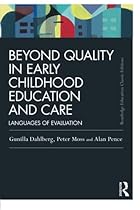
Beyond Quality in Early Childhood Education and Care: Languages of evaluation (Routledge Education Classic Edition)
| Author | : | |
| Rating | : | 4.28 (917 Votes) |
| Asin | : | 0415820227 |
| Format Type | : | paperback |
| Number of Pages | : | 248 Pages |
| Publish Date | : | 2013-10-22 |
| Language | : | English |

DESCRIPTION:
It places these issues in a global context and draws on work from Canada, Sweden and Italy, including the world famous nurseries in Reggio Emilia.Working with postmodern ideas, this book questions the search to define and measure quality in the early childhood field and its tendency to reduce philosophical issues of value to purely technical and managerial issues of expert knowledge and measurement.With a brand new Preface to this classic text, the authors argue that there are other ways than the 'discourse of quality' for understanding and evaluating early childhood pedagogical work and relate these to alternative ways of understanding early childhood itself and the purposes of early childhood institutions.. Taking a broad approach, Beyond Quality in Early Childhood Education and Care relates issues of early childhood to the sociology of childhood, philosophy, ethics, political science and other fields and to an analysis of the world we live in today
Gunilla Dahlberg is Professor at the Institute of Education, Stockholm, Sweden.Peter Moss is Emeritus Professor of Early Childhood Provision at the Institute of Education, University of London, UK.Alan Pence is Professor at the School of Child and Youth Care, University of Victoria, Canada.
Five Stars Andrea Benasus Fantastic
'The authors of this book offer a wonderful provocation for early childhood professionals. Good because it is the product of dialogue and because it offers itself not only for consent, but also for dissent and negotiation by its non-dogmatic tone. 'This is a book that is strongly innovative and uncomfortable for those who would like to see the ideas of quality and assessment consolidated in our society and in contemporary western culture. The places the authors describe that are ‘beyond quality’ open exciting and challenging possibilities for the field of ECE.' (Elizabeth Jones, Faculty Emerita, Human Development, Pacific Oaks College, California). Reading it, I found myself encountering new and irresistible ideasones that led me to my own playful tangents. Readers will feel welcomed, listened to and respected in their opinions, even when those